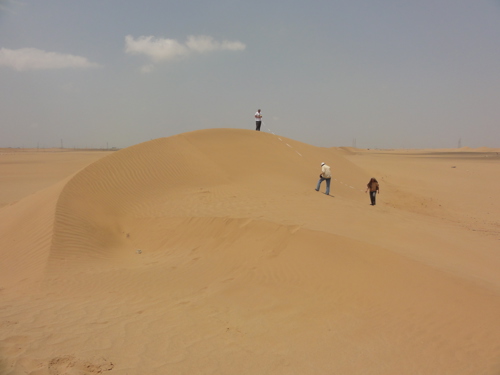


Sand Dunes Hazard:
Dunes and sand clusters cover vast areas of the world in general and in the Kingdom of Saudi Arabia in particular, where the sand clusters cover a large percentage of the Kingdom’s area, amounting to about 635,000 km2, representing 33% of the total area of the Kingdom. The sands of the Empty Quarter, Al-Nafout Al-Kabir, Al-Dahna, and Al-Jafoura are the largest sand seas. In the Kingdom, it poses a major threat to the region because of its spread around cities, villages, road networks, farms, water sources, irrigation, and pastures. They are largely concentrated in the Arab Pavement, and despite the efforts being made to limit their movement, studies indicate that the random movement of dunes is continuing, and most countries face severe problems resulting from the encroachment of sand dunes, which are considered the last stages of desertification. Their movement threatens agricultural lands, natural pastures, economic facilities, and social life in the region.
For a long time, man has tried in various ways to resist the encroachment of sand, but his capabilities were limited, which often led him to forcefully abandon his lands and leave them to the sand.
Climatic factors are considered the most important environmental factors that affect the ecosystem and make it a sensitive and unstable ecosystem. Most sand dunes are located in areas where a desert climate prevails, characterized by a long period of drought, scarcity, or absence of rain, high summer temperatures, and strong and continuous winds throughout the year